How to generate QR Code and sign document using Python Leave feedback
On this page
The generated QR Code can be downloaded and used to add to the business contracts and official documents. Any QR Code contains unique textual information that confirms the identity of the signer or authorizes the business document. QR Code verification could be performed automatically by reading the contents of the QR Code embedded data. These signatures could be scanned automatically. The QR Code allows keeping over 2 Kilobytes of data.
GroupDocs.Signature for Python via .NET provides API for signing a wide range of document formats. Moreover, API includes special abilities for additional document content processing. Supported formats are PDF, Microsoft Word, Microsoft PowerPoint, Microsoft Excel, PNG, JPEG, and many others.
Use pip to install the package:
pip install groupdocs-signature-net
Sometimes it is needed to inform coworkers about business events. In such cases, an Event QR code can provide all the required information in a very effective way. This topic describes how to sign a PDF document with the generated Event QR code.
- Instantiate the
Signatureclass providing the path to the source document or document stream. - Set event data in the Event object instance.
- Create the QrCodeSignOptions object and set up all demanded fields. The event goes into the
dataproperty; the QR code then carries it in the iCalendarVEVENTformat. - Invoke the
signmethod to process the document, providing output file path and sign options.
from datetime import datetime

from groupdocs.signature import Signature
from groupdocs.signature.domain import HorizontalAlignment, QrCodeTypes, VerticalAlignment
from groupdocs.signature.domain.extensions import Event
from groupdocs.signature.options import QrCodeSignOptions


def sign_pdf_with_event_qr_code():
    # Initialize signature handler
    with Signature("sample.pdf") as signature:
        # Provide event data
        event_qr = Event()
        event_qr.title = "Meeting"
        event_qr.description = "Productivity issues"
        event_qr.location = "room 408"
        event_qr.start_date = datetime(2022, 6, 19, 15, 30, 0)
        event_qr.end_date = datetime(2022, 6, 19, 17, 0, 0)

        # Setup QR code signature options
        qr_options = QrCodeSignOptions()
        qr_options.horizontal_alignment = HorizontalAlignment.RIGHT
        qr_options.vertical_alignment = VerticalAlignment.BOTTOM
        qr_options.encode_type = QrCodeTypes.QR
        qr_options.data = event_qr

        # Sign document
        result = signature.sign("signed_event.pdf", qr_options)
        print(f"QR codes added: {len(result.succeeded)}")


if __name__ == "__main__":
    sign_pdf_with_event_qr_code()
sample.pdf is the sample file used in this example. Click here to download it.
Binary file (PDF, 122 KB)
The result of signing a document may look like the picture below. Such QR codes can be very useful for organizing events.
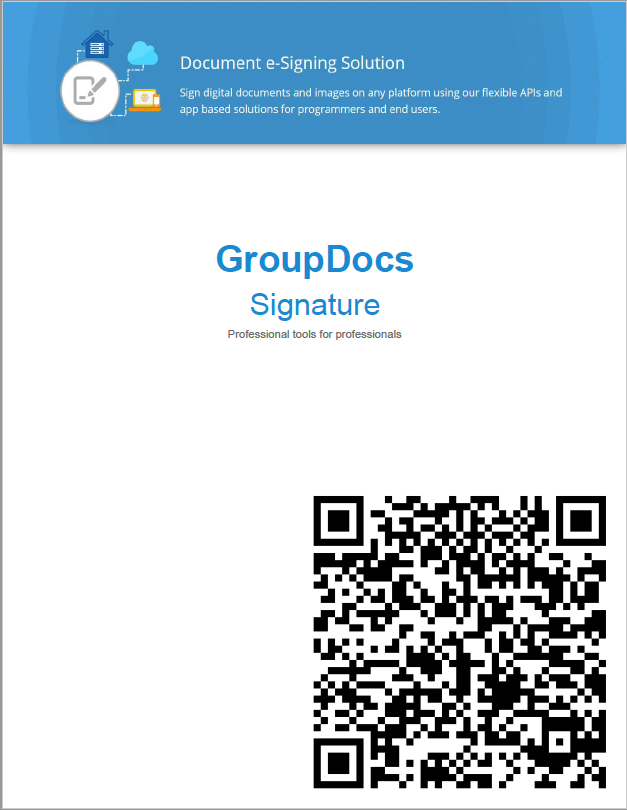
To try signing documents with QR codes for free, you may use the QR Code Generator Online App.
Another way to improve documents is to generate the QR code first and then add it to documents using third-party tools. For this case, it is possible to generate code as an image.
- Create the
QrCodeSignOptionsinstance and set up all demanded fields. - Instantiate the PreviewSignatureOptions object providing the methods for creation and releasing of the image stream.
- Invoke the static
Signature.generate_signature_previewmethod to obtain the QR code image as a stream. - Use the resultant QR Code stream in any possible way.
import io

from groupdocs.signature import Signature
from groupdocs.signature.domain import QrCodeTypes
from groupdocs.signature.options import PreviewSignatureOptions, QrCodeSignOptions


def generate_qr_code_image():
    # Create a memory stream to store the QR code image
    result = io.BytesIO()

    # Setup QR code signature options
    qr_options = QrCodeSignOptions()
    qr_options.encode_type = QrCodeTypes.QR
    qr_options.text = "Case 148-01"

    # Create preview options
    preview_options = PreviewSignatureOptions(
        qr_options,
        lambda options: result,  # Create the image stream
        lambda options, stream: None,  # Release the image stream
    )

    # Generate image to stream; no document is needed
    Signature.generate_signature_preview(preview_options)

    # Use the QR code image, for example save it for a third-party tool
    with open("qr_code_result.png", "wb") as image_file:
        image_file.write(result.getvalue())
    print(f"QR code image: {len(result.getvalue())} bytes")


if __name__ == "__main__":
    generate_qr_code_image()
Binary file (PNG, 2 KB)
An image with the generated QR Code may look as below:

To use the API without evaluation limitations, you can get a free temporary license.
To sum up, some useful ways of processing documents with QR codes were discussed in this article. Using Python improves the productivity of such actions dramatically. In addition, you can use the QR Code Generator Online App to generate QR codes and/or sign your files with QR codes for free.
Read the documentation to learn how to use GroupDocs.Signature in your Python applications. Also, you may discuss any questions or issues at the GroupDocs forum.
- How to sign documents with barcodes using Python
- How to sign Excel spreadsheets and their macros using Python
Was this page helpful?
Any additional feedback you'd like to share with us?
Please tell us how we can improve this page.
Thank you for your feedback!
We value your opinion. Your feedback will help us improve our documentation.