Working with Lazy And Recursive Access of Data Leave feedback
NoteThis feature is supported by GroupDocs.Assembly for Java 26.10 or greater.
At some point, you may want to generate a report over an object graph whose shape is not known in advance, fetching its data lazily (only when a template actually requests it) and recursively (following related and child entities) using GroupDocs.Assembly for Java. This is quite possible to accomplish using custom types.
A template reads a property of such an entity with indexer syntax, for example root["Name"]: the engine resolves an indexer on a Java type through its public get(String) method. Related and child entities are exposed as public fields (Entities and Children in the example below), whose types in turn provide get(String) methods returning a single entity or an Iterable of entities.
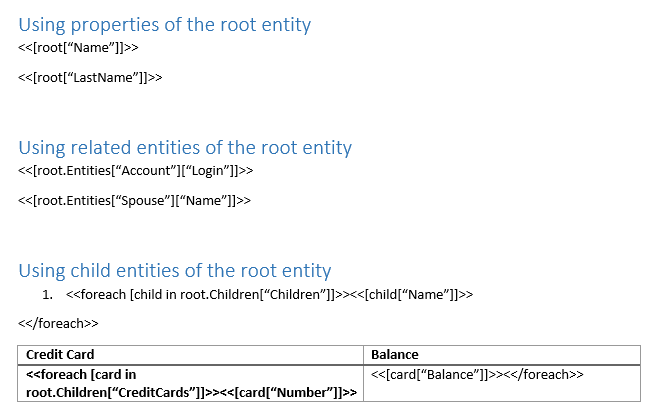
The template uses the following expressions: root["Name"] to read a property of the root entity, root.Entities["Account"]["Login"] to read a property of a related entity, and <<foreach [child in root.Children["Children"]]>> to iterate over child entities.
Get template from here.
import com.groupdocs.assembly.*;
import java.util.UUID;

public static void lazilyAndRecursively() throws Exception
{
    DynamicEntity entity = new DynamicEntity(UUID.randomUUID());

    DocumentAssembler assembler = new DocumentAssembler();

    assembler.assembleDocument("Lazy and Recursive.docx", "Lazy and Recursive Out.docx",
        new DataSourceInfo(entity, "root"));
}
The DynamicEntity class used above is defined as follows:
import java.util.Arrays;
import java.util.UUID;

/**
 * An entity whose properties are fetched by name rather than declared, so a report can be generated
 * lazily and recursively over an object graph of unknown shape.
 */
public class DynamicEntity
{
    /**
     * Provides access to individual related entities by their names.
     */
    public final ReferencedEntities Entities;

    /**
     * Provides access to enumerations of related entities by their names.
     */
    public final ChildEntities Children;

    private final UUID mId;

    public DynamicEntity(UUID id)
    {
        // In this example we use UUID to represent an entity identifier. In a real-life application
        // the identifier can be of any type or even missing.
        mId = id;

        // In this example we simply initialize the fields in the constructor. In a real-life
        // application the lookups below can fetch their data lazily, when they are first called.
        Entities = new ReferencedEntities(this);
        Children = new ChildEntities(this);
    }

    /**
     * Gets a property value by its name.
     */
    public String get(String propertyName)
    {
        // In this example we simply return a property name as its value. In a real-life application
        // a real property value should be returned. This value can be cached using for example a
        // Map, or fetched every time the property is requested.
        return propertyName + " Value";
    }

    public static class ReferencedEntities
    {
        private final DynamicEntity mRootEntity;

        ReferencedEntities(DynamicEntity rootEntity)
        {
            // The reference to the root entity allows to access fields of the root entity (such as
            // an identifier) in the lookup below for a real-life application.
            mRootEntity = rootEntity;
        }

        public DynamicEntity get(String propertyName)
        {
            // In this example we simply return the root entity. In a real-life application an entity
            // corresponding to propertyName for the given root entity should be returned.
            return mRootEntity;
        }
    }

    public static class ChildEntities
    {
        private final DynamicEntity mRootEntity;

        ChildEntities(DynamicEntity rootEntity)
        {
            mRootEntity = rootEntity;
        }

        public Iterable<DynamicEntity> get(String propertyName)
        {
            // In this example we simply return the root entity three times. In a real-life application
            // the entities corresponding to propertyName for the given root entity should be returned.
            return Arrays.asList(mRootEntity, mRootEntity, mRootEntity);
        }
    }
}
Was this page helpful?
Any additional feedback you'd like to share with us?
Please tell us how we can improve this page.
Thank you for your feedback!
We value your opinion. Your feedback will help us improve our documentation.


